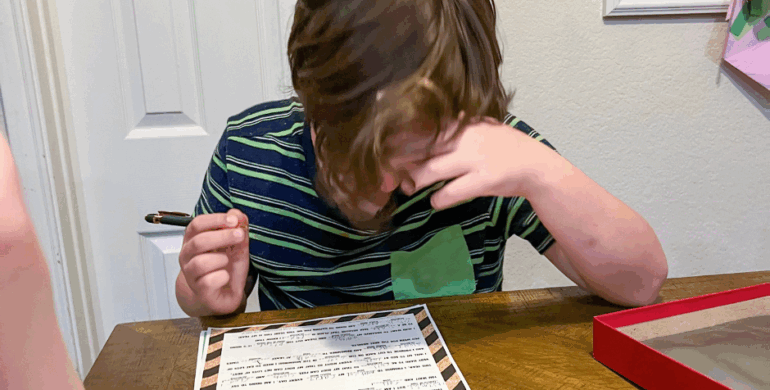
What if bad handwriting is more than bad handwriting? Can bad handwriting be helped? These are questions I wish I had asked sooner.
My son’s 4th grade teacher mentioned that she wanted to meet with me to discuss concerns about his penmanship. I am well aware of this concern, as every single teacher he has had has brought it up. I wasn’t looking forward to the meeting because I thought it would be more of the same. The teacher would explain how bad his handwriting was, and I would commit to giving him extra handwriting practice at home. I know the drill; this is something we’ve been working on for a long time.
We’ve gone through so many different handwriting books. Everyone always wants to recommend “Handwriting Without Tears” to me as if I’ve never heard of it before, when in reality, I pretty much have all of the books that they make. And trust me, there HAVE been tears.
My son was able to complete the handwriting exercises, although the process was always slow. But even still, while doing actual schoolwork, it didn’t seem to make a huge difference. After several years, I just kind of resigned myself to the fact that he might just never have “good” handwriting. You can win ’em all, right? After all, it’s not like his siblings had amazing handwriting, or his dad. I can’t necessarily expect some magically different results. Bad handwriting isn’t the worst thing in the world, I thought.
But my meeting with my son’s teacher ended up being very different. She said, “I think your son has dysgraphia,” and then went on to describe that dysgraphia was a learning disability related to handwriting and listed some of the signs she had observed that indicated to her that this was more than just a regular handwriting struggle. The spacing of his letters was unusual, the sizes of his letters varied quite a bit, he often wrote capital letters where they weren’t supposed to be, punctuation was regularly missing, words were often spelled phonetically, and there were a few other things that were atypical. On top of all that, he struggled with the process of writing assignments, becoming visibly frustrated when trying to transfer his ideas onto paper.
As we talked, everything seemed to make sense. In that moment, I felt a huge sense of relief! There was a reason why this task was so difficult for him.
The next step was an evaluation by the school. They evaluated him for dysgraphia and dyslexia since they often occur together. This process took a while, but when we had a meeting to discuss the results, I was in for a surprise. My son did, indeed, have dysgraphia. But he also had dyslexia. This was shocking to me. Yes, he had struggles with spelling, but he was still fairly young, and I didn’t think it was extremely out of the ordinary. Even the teacher did not suspect he had dyslexia. He reads fairly well and was not behind whatsoever. But when they broke it down to the basics during the testing, it was clear that this was dyslexia. He had just compensated so well for so long, no one knew it.
Even still, dyslexia did make sense in retrospect. We had started spelling homework that year, which was new for us, and particularly challenging. I didn’t understand why.
We had a meeting for his IEP, and it was very thorough and included all the necessary accommodations he would need. Most of his accommodations could be handled by the school-issued chromebook and included things like being able to type his assignments, spell-check, having books read aloud to him, and other things, too. He also started dyslexia therapy in school 5 days a week for 45 minutes.
The whole process from the teacher bringing up her concerns to having an IEP finalized took about six months, and I’m told that’s typical (good, even).
Things have gone fairly well since then. I’m extremely grateful for technology and all of the capabilities that are available to students to use. Everyone has been so supportive, which I know doesn’t always happen, and for that, I’m even more grateful.
Reading and writing may look a little different at our house these days, but at least now we have the information and support needed to help him thrive!
You Might Also Like:
- Top 10 Best Memes of 2025
- Gifts Moms Actually Want
- Funny Christmas Memes Parents Can Relate To
- The Ultimate Guide For Holiday Gifts For the Whole Family
- 15 Unhinged Mental Health Memes That Will Leave You Cackling
